Category: Dental Claims

  • How Dental Claims Management Impacts the Overall Patient Experience

    How Dental Claims Management Impacts the Overall Patient Experience

    Dental Claims Management plays an important role in shaping the patient experience. When claims are processed accurately and on time, patients receive clearer financial information, fewer unexpected balances, and faster answers. Delays or denials can create frustration and make financial communication harder for the dental practice.

    A smooth claims workflow helps dental teams reduce errors and administrative pressure. Instead of spending time correcting claim issues and following up on missing information, staff can focus on patient communication and front-office responsibilities. This creates a more organized experience from treatment planning through payment.

    For practice leaders, effective claims handling supports patient confidence, staff efficiency, and better financial visibility. A well-structured process keeps insurance tasks moving efficiently while helping patients receive timely and consistent communication through Dental Claims Management.

    What Is Dental Claims Management?

    Dental Claims Management is the process of preparing, submitting, tracking, and following up on dental insurance claims. It includes eligibility checks, patient information, coding, documentation, claim submission, payment posting, and denial follow-up.

    Each step affects the next. Incorrect insurance details, coding errors, or missing documentation can delay payments, trigger denials, and create additional patient balances. Regular claim tracking helps practices resolve issues before they become aging accounts.

    A structured workflow improves consistency by verifying information, submitting complete claims, monitoring status, and responding to payer requests. It also helps staff explain estimates and balances more clearly,while an organized Dental Billing workflow makes claim and patient-balance information easier to manage 

    How Does Dental Claims Management Impact Patient Experience?

    1. Creates Clear Financial Expectations

    • Verify Insurance Benefits: Check eligibility, deductibles, annual maximums, waiting periods, and coverage details to give patients a clearer idea of their benefits.
    • Confirm Patient Responsibility: claim submission practices, such as those outlined in Submit Dental Insurance Claims, can further support clear financial expectations and reduce avoidable claim-related issues. 

    2. Reduces Billing Surprises

    • Submit Accurate Claims: Review patient details, provider information, procedure codes, documentation, and attachments before submitting claims to prevent avoidable errors.
    • Prevent Unexpected Balances: A well-managed claims process helps identify issues early, reducing incorrect bills, repeated follow-ups, and confusing patient statements.

    3. Improves Response Times

    • Track Claim Status: Monitor submitted claims, payer responses, and payments so staff can quickly find the information patients need. Understanding the Dental Insurance Claims Process helps practices track claims from submission through follow-up.
    • Provide Faster Answers: Easy access to claim details allows the billing team to respond to patient questions more accurately and reduce unnecessary calls or delays.

    4. Supports a Smoother Treatment Journey

    • Coordinate the Billing Process: Connect insurance verification, claim submission, payment posting, and follow-up to create a more organized administrative experience.
    • Reduce Administrative Friction: Timely claims processing and clear communication help patients avoid repeated document requests, delayed resolutions, and unnecessary billing issues.

    5. Builds Patient Trust and Satisfaction

    • Maintain Accurate Accounts: Keep payments, adjustments, insurance balances, and patient balances updated so statements remain accurate and easier to understand.
    • Improve the Overall Experience: Consistent Dental Claims Management helps the practice provide clearer financial communication, faster issue resolution, and a more reliable patient experience.

    What Are the Benefits of Outsourcing Dental Claims Management?
    Outsourcing dental claims management gives practices access to specialized Medical Billing support for claim preparation, submission, follow-up, and insurance-related tasks. 

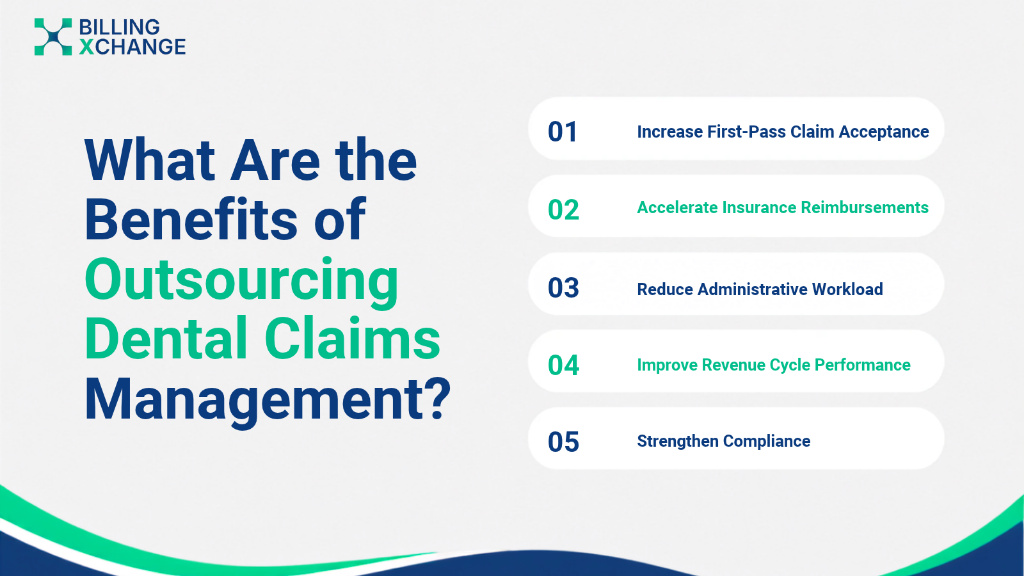
    Increase First-Pass Claim Acceptance

    • Improve claim accuracy before submission.
    • Reduce avoidable claim rejections and resubmissions.
    • Support compliance with payer requirements.
    • Increase the number of claims accepted on the first submission.

    Accelerate Insurance Reimbursements

    • Support faster insurance payment processing.
    • Reduce delays caused by incomplete or incorrect claims.
    • Improve cash-flow predictability.
    • Maintain more consistent reimbursement performance.

    Reduce Administrative Workload

    • Reduce manual claim corrections and repetitive billing tasks.
    • Give staff more time for patient communication and scheduling.
    • Simplify billing workflows and improve staff productivity.
    • Allow specialized teams to manage complex claims responsibilities.

    Improve Revenue Cycle Performance

    • Strengthen accounts receivable management.
    • Reduce avoidable revenue leakage.
    • Improve follow-up on unpaid and denied claims.
    • Give practice owners better visibility into billing performance.

    Strengthen Compliance

    • Maintain accurate billing and supporting documentation.
    • Follow payer-specific claim submission requirements.
    • Reduce compliance risks caused by inconsistent processes.
    • Support more consistent and accurate claim submissions.

    Dental Claims Management: Practice Impact and Key Benefits

    Practice Impact Key Benefit 
    Patient ExperienceClear billing and better communication.
    Outsourcing BenefitsFaster claims and less workload.
    Key FocusFewer errors and delays.
    Practice ImpactBetter efficiency and visibility.
    Overall BenefitSmoother claims management.

    How Can Technology Improve Dental Claims Management?

    Technology can strengthen Dental Claims Management by reducing manual work, improving claim accuracy, and providing better visibility throughout the claims lifecycle.

    1. Automate Eligibility and Data Checks

    • Verify insurance eligibility and patient coverage before claim submission.
    • Identify inactive coverage, missing information, or mismatched patient details.
    • Reduce errors that can lead to claim delays or rework.

    2. Validate Claims Before Submission  

    • Check claims for missing fields, incomplete information, and documentation issues.
    • Identify errors before submission to reduce preventable denials and rework through structured Dental Claims Management Reduce and Denials.
    • Support cleaner claims and reduce preventable rejections and resubmissions.

    3. Improve Claim Status Visibility

    • Track submitted, accepted, pending, paid, and denied claims in one system.
    • Make it easier for billing teams to identify claims requiring follow-up.
    • Reduce time spent searching across multiple systems.

    4. Streamline Documentation and Attachments

    • Connect clinical documentation with the claim submission workflow.
    • Attach required records, images, and narratives more efficiently.
    • Reduce manual handling and the risk of incomplete claim submissions.

    5. Monitor Performance and Identify Trends

    • Track denial reasons, payment delays, claim status, and workflow performance.
    • Identify recurring billing issues and payer-related bottlenecks.
    • Use reporting insights to improve the consistency and efficiency of the claims process..

    Why Choose BillingXchange for Dental Claims Management?

    BillingXchange supports dental practices with structured claims workflows, timely follow-up, accurate processing, and clear communication. These processes help reduce administrative work, improve financial visibility, and keep claims moving efficiently through each stage.

    Its consistent approach can also help practices manage growing claim volumes while reducing avoidable billing issues that may affect patients. By maintaining organized processes, practices can address potential problems earlier and minimize unnecessary delays.

     Effective Dental Claims Management supports smoother financial administration, fewer billing obstacles, and a more transparent patient experience. 

    Conclusion

    The connection between claims and patient experience is easy to underestimate. Delays, unexpected balances, or unclear insurance information can create frustration for patients. Effective Dental Claims Management improves accuracy, follow-up, visibility, and communication, helping reduce these common friction points.

    A disciplined claims workflow also supports timely reimbursement and reduces administrative work. With the right people, processes, and technology, BillingXchange can help dental practices improve financial clarity and provide patients with a more consistent, transparent experience.

    Give your patients a smoother experience with efficient Dental Claims Management. BillingXchange supports accurate claim processing, timely follow-up, and fewer avoidable billing issues. Get in touch Contact us today to improve your practice’s claims process. 

    Frequently Asked Questions(FAQS)

    1. What Is the Main Goal of Dental Claims Management?

    The main goal is to process insurance claims accurately and efficiently, from verification through payment and follow-up. This helps reduce avoidable delays, denials, rework, and patient confusion about financial responsibility.

    2. How Does Dental Claims Management Improve Patient Satisfaction?

    It supports clearer estimates, faster answers, fewer preventable billing issues, and more consistent communication. Patients benefit when the practice can quickly explain claim status and next steps. Practices can also review their submission workflow using guidance on Submit Dental Insurance Claims.

    3. Is Outsourcing Dental Claims Management Worth It for a Growing Practice?

    Outsourcing can be valuable when internal staff spend significant time on submissions, follow-up, denials, and payment-related tasks. A specialized team can provide process consistency while allowing practice staff to focus on patient-facing responsibilities.

    4. Can Technology Prevent Every Dental Claim Denial?

    No. Technology can identify many preventable issues, improve data accuracy, support documentation, and make follow-up easier. However, payer rules and individual claim circumstances can still create exceptions. Strong Dental Claims Management processes and human review remain important.

    5. What Should a Practice Look for in a Dental Claims Partner?

    Look for experience with dental insurance workflows, clear communication, disciplined follow-up, reporting visibility, data security, and a process focused on reducing avoidable errors. The partner should also fit the practice’s systems and operational goals.

  • What Is the Dental Insurance Claims Process and How Does It Affect Your Bill?

    What Is the Dental Insurance Claims Process and How Does It Affect Your Bill?

    For dental practices, understanding the Dental Insurance Claims Process helps reduce payment delays, billing errors, and revenue uncertainty.

    For dental groups, DSOs, and multi-location practices, efficient claims management ensures accurate coding, timely submissions, and better reimbursement tracking.

    This guide explains how the Dental Insurance Claims Process works, affects patient bills, and helps practices improve claims efficiency.

    What Is the Dental Insurance Claims Process?

    The Dental Insurance Claims Process includes the steps a dental practice follows to request insurance payment after treatment. It starts with collecting patient information, verifying eligibility, documenting treatment, coding procedures, and submitting the claim.

    The insurance company reviews the claim and may approve payment, request additional information, partially approve it, or deny it. The practice then posts the payment and determines the remaining patient balance.

    According to the Lifecycle of a Dental Insurance Claim Process, effective claim management covers multiple stages from patient information to final reimbursement. For dental organizations, managing each stage efficiently supports a more predictable revenue cycle.

    How Does the Dental Insurance Claims Process Work?

    The Dental Insurance Claims Process follows several connected stages, from patient registration to payment posting. Each stage helps dental practices improve claim accuracy, reduce delays, and maintain a smoother revenue cycle.

    Patient Registration & Insurance Verification

    • Accurate Patient Information: Collect complete demographic, insurance, and subscriber details to prevent claim errors.
    • Eligibility Verification: Confirm active coverage, benefits, deductibles, limitations, and other plan requirements before treatment.

    Treatment & Documentation

    • Complete Treatment Records: Maintain treatment notes, diagnostic information, radiographs, photographs, and required supporting documents.
    • Strong Documentation: Accurate records give insurance payers the information needed to evaluate and process claims.

    Coding & Charge Capture

    • Accurate CDT Coding: Assign the correct dental procedure codes and capture all applicable treatment charges.
    • Fewer Claim Errors: Correct coding reduces delays, documentation requests, and potential claim denials.

    Claim Creation & Submission

    • Complete Claim Preparation: Include accurate patient, provider, procedure, treatment date, charge, and required documentation details.
    • Timely Submission: Submit claims electronically or through the payer-approved method to support faster processing.

    Payer Adjudication

    • Claim Review: The insurance payer reviews submitted information against the patient’s policy and coverage rules.
    • Payment Determination: The payer calculates the allowed amount, insurance payment, adjustments, and patient responsibility.

    Payment Posting & Follow-Up

    • Accurate Payment Posting: Record insurance payments, adjustments, and remaining patient balances after claim processing.
    • Denial Follow-Up: Investigate denied or underpaid claims, provide additional documentation, correct errors, or submit appeals when necessary.

    The Dental Insurance Claim Process services approach shows why consistent coordination across these stages is important for efficient claims management.

    How Does the Dental Insurance Claims Process Affect Your Bill?

    The Dental Insurance Claims Process can directly affect the amount a patient ultimately pays. The final balance depends on how the insurance plan applies deductibles, coinsurance, coverage limits, and other adjustments.

    1: Review Insurance Coverage

    • Deductibles: The amount the patient must pay before insurance begins contributing.
    • Annual Maximums: The maximum amount the insurance plan may pay during the benefit year.
    • Frequency Limitations: Restrictions on how often certain dental procedures are covered.
    • Non-Covered Services: Treatments excluded from the patient’s insurance plan.

    2: Process the Insurance Claim

    • Claim Approval: Insurance pays according to the patient’s eligible benefits.
    • Partial Payment: The payer may cover only a portion of the allowed treatment amount.
    • Claim Denial: The practice may need to correct, resubmit, or appeal the claim.
    • Contractual Adjustments: The provider adjusts charges according to the insurance agreement.

    3: Calculate Patient Responsibility

    • Coinsurance: The patient pays a percentage of the allowed amount.
    • Copayments: A fixed amount may be required for certain covered services.
    • Remaining Balance: Any eligible amount not paid by insurance may become the patient’s responsibility.

    4: Communicate the Final Bill

    • Clear Cost Estimates: Practices can explain expected insurance and patient portions before treatment.
    • Accurate Statements: Final bills should reflect insurance payments, adjustments, and remaining balances.
    • Better Financial Transparency: Clear communication helps reduce billing confusion and unexpected patient expenses.

    How Is a Dental Insurance Claim Submitted?

    A Dental Insurance Claims Process requires accurate information and careful review before submission. Following a structured workflow helps dental practices reduce errors, avoid delays, and improve claim processing.

    Step 1: Collect Claim Information

    • Patient name and date of birth
    • Member and group information
    • Subscriber details
    • Provider identification information
    • Procedure codes
    • Treatment dates
    • Billed charges

    Step 2: Verify Claim Details

    • Required clinical documentation
    • Coordination of benefits information
    • Required attachments
    • Accurate procedure codes
    • Correct patient and insurance information
    • Complete provider details

    Step 3: Submit the Claim

    • Submit claims electronically when available
    • Use the payer-approved submission method
    • Confirm successful claim transmission
    • Retain submission records for tracking

    Step 4: Monitor and Follow Up

    • Track claim status after submission
    • Respond to payer requests for additional information
    • Correct and resubmit rejected claims
    • Follow up on delayed or unpaid claims

    A strong Dental Billing workflow combines accurate claim preparation with consistent follow-up. For high-volume dental organizations, standardized processes can reduce rework and improve overall claims efficiency.

    How Can Patients Avoid Unexpected Dental Bills?

    Dental practices can help patients avoid unexpected costs by following a clear approach throughout the Dental Insurance Claims Process.

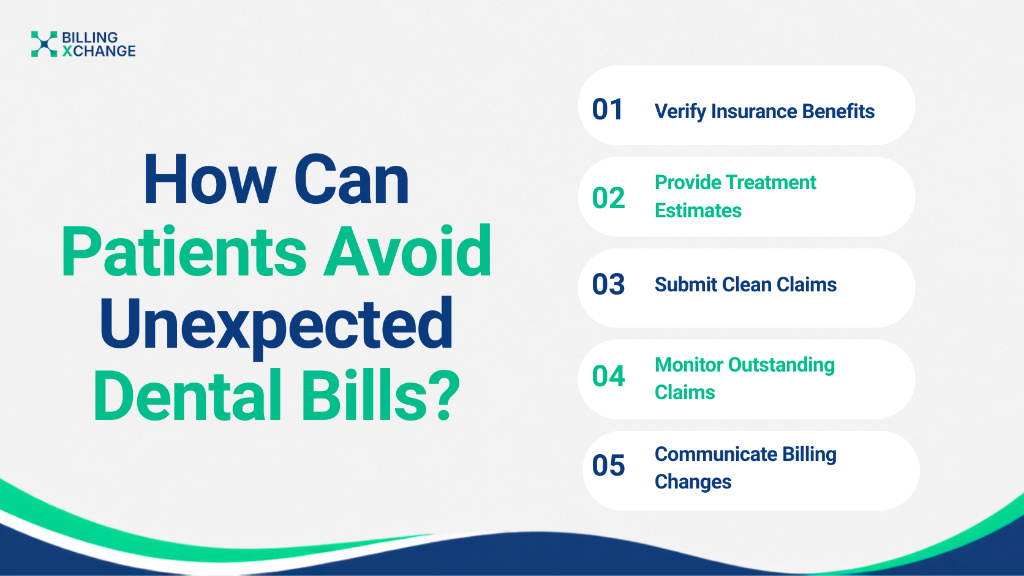
    1. Verify Insurance Benefits

    • Check active coverage, deductibles, annual maximums, waiting periods, and frequency limitations before treatment.
    • Review covered and non-covered services to provide patients with accurate cost expectations.

    2. Provide Treatment Estimates

    • Give patients an estimate of the expected insurance contribution and potential out-of-pocket costs.
    • Explain deductibles, coinsurance, copayments, and other possible charges before treatment.

    3. Submit Clean Claims

    • Verify patient information, procedure codes, treatment dates, and required documentation before submission.
    • Accurate claims can reduce avoidable delays, rejections, and billing changes.

    4. Monitor Outstanding Claims

    • Track pending, rejected, denied, and unpaid claims regularly.
    • Follow up promptly on payer requests and unresolved claim issues.

    5. Communicate Billing Changes

    • Explain any difference between the original estimate and the payer’s final determination.
    • Provide clear statements showing insurance payments, adjustments, and the remaining patient balance.

    Dental Insurance Claim and Bill Process 

    StepWhat HappensHow It Affects the Bill
    Verify InsuranceThe practice checks coverage and benefits.Shows what insurance may cover.
    Provide TreatmentTreatment is completed and documented.Creates the basis for the claim.
    Submit ClaimTreatment details are sent to the insurer.Start the payment process.
    Insurance ReviewThe insurer reviews and decides the claim.Determines how much insurance pays.
    Apply Patient CostsDeductibles, coinsurance, and non-covered costs are applied.Determines the patient’s share.
    Final BillInsurance payment is posted and the balance is calculated.Shows the final amount the patient owes.

    Why Choose BillingXchange for Dental Insurance Claims Process?

    For dental organizations, managing high claim volumes, payer requirements, denials, and follow-ups internally can increase administrative workload and delay reimbursements. BillingXchange provides structured claims management workflows to support smoother revenue-cycle operations.

    A dedicated approach helps dental practices improve claim preparation, submission, status monitoring, denial follow-up, payment posting, and accounts receivable management. This allows internal teams to focus more on practice operations.

    For organizations handling broader healthcare operations, coordinated Medical Billing support can provide greater consistency across revenue-cycle functions. A well-managed Dental Insurance Claims Process can help improve collections, reduce avoidable delays, and create more predictable financial performance.

    Conclusion

    The Dental Insurance Claims Process directly affects reimbursement speed, administrative efficiency, and patient financial responsibility. An effective process requires accurate verification, documentation, coding, claim submission, follow-up, and payment posting.

    A structured approach can reduce errors, improve accounts receivable performance, and create more predictable revenue. BillingXchange helps dental organizations streamline claims workflows, allowing teams to focus on practice operations and patient care.

    Improve your Dental Insurance Claims Process and reduce billing delays with expert support.  Let help streamline claims, follow-ups, and revenue-cycle operations. Contact us today  for BillingXchange to discuss your dental claims management needs.

    Frequently Asked Questions (FAQS)

    1. What Information Is Needed to Submit a Dental Insurance Claim?

    A dental claim typically requires accurate patient and subscriber information, insurance details, provider information, procedure codes, treatment dates, charges, and any required clinical documentation or attachments.

    2. What Happens After a Dental Insurance Claim Is Submitted?

    After submission, the insurance payer reviews the claim against the patient’s coverage and applicable requirements. The payer may approve the claim, make an adjustment, request additional information, or deny the claim.

    3. Why Can a Dental Insurance Claim Be Delayed?

    A claim may be delayed because of incorrect patient information, missing documentation, coding errors, incomplete insurance details, coordination-of-benefits issues, or additional information requested by the payer.

    4. What Happens When a Dental Insurance Claim Is Denied?

    When a claim is denied, the dental practice reviews the denial reason and identifies the required correction or documentation. Depending on the issue, the practice may correct and resubmit the claim or submit an appeal.

    5. How Can Dental Practices Improve Claim Processing?

    Dental practices can improve claim processing by verifying insurance information, maintaining accurate treatment documentation, using correct procedure codes, submitting complete claims, monitoring claim status, and following up on unpaid or denied claims.

  • The Impact of Accurate Dental Claim Submission Services on Practice Profits

    The Impact of Accurate Dental Claim Submission Services on Practice Profits

    Claim Submission Services help dental practices overcome growing administrative demands, complex payer requirements, and constant pressure to maintain healthy cash flow. Even small billing errors can delay reimbursements, increase operational costs, and reduce overall profitability.

    Reliable claim management reduces errors, speeds up reimbursements, and allows dental teams to focus more on patient care instead of time-consuming administrative work. For DSOs, multi-location practices, and independent dental offices, accurate submissions support stronger financial performance.

    As payer requirements continue to evolve, practices need dependable solutions that improve collections and minimize revenue loss. Investing in professional claim management builds a more efficient, profitable, and sustainable revenue cycle through Claim Submission Services.

    What Are Dental Claim Submission Services?

    Claim Submission Services are professional solutions that prepare, review, and submit dental insurance claims accurately while meeting payer-specific requirements. They verify CDT codes, patient information, supporting documentation, and claim completeness before submission to reduce errors and improve first-pass acceptance rates.

    Unlike basic claim processing, comprehensive Claim Submission Services emphasize quality checks before claims reach insurance companies. This proactive approach minimizes delays, accelerates reimbursements, and strengthens practice profitability.

    Many practices also integrate Dental Billing into their revenue cycle strategy to improve operational efficiency and maintain accurate insurance claim management.

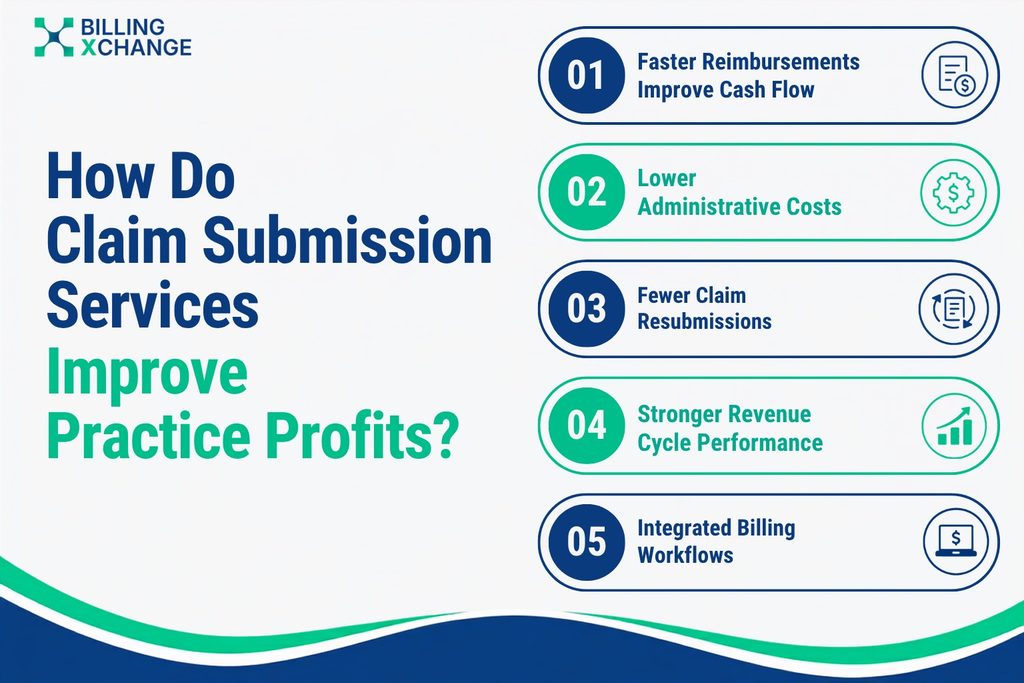
    How Do Claim Submission Services Improve Practice Profits?

    Practice profitability depends on timely reimbursements and efficient revenue cycle management. Accurate Claim Submission Services help practices increase first-pass claim acceptance, reduce resubmissions, and improve overall financial performance.

    Faster Reimbursements Improve Cash Flow

    • Higher First-Pass Claim Acceptance: Clean and accurate claims move through payer systems faster, reducing payment delays and improving cash flow.
    • Improves Financial Stability: Faster reimbursements provide consistent revenue, helping practices manage daily operations and future investments.

    Lower Administrative Costs

    • Reduces Manual Rework: Billing specialists identify and correct errors before submission, minimizing costly claim corrections.
    • Improves Staff Productivity: Administrative teams spend less time on resubmissions and more time supporting patient care and practice operations.

    Fewer Claim Resubmissions

    • Accurate Documentation: Complete patient information, correct CDT codes, and required attachments reduce claim rejections.
    • Higher Operational Efficiency: Fewer resubmissions lower administrative expenses and accelerate insurance payments.

    Stronger Revenue Cycle Performance

    • Better Revenue Visibility: Consistent claim acceptance improves cash flow forecasting and accounts receivable management.
    • Supports Sustainable Growth: Efficient billing processes help practices expand confidently while maintaining financial stability.

    Integrated Billing Workflows

    • Medical Billing Integration: Combining Medical Billing with dental billing creates a more streamlined revenue cycle for multi-specialty organizations.
    • Lifecycle Monitoring: Understanding the Lifecycle of a Dental Claim helps identify bottlenecks, improve reimbursement timelines, and strengthen financial performance.

    Business Benefits of Claim Submission Services 

    Business GoalImpact of Claim Submission Services
    Revenue GrowthImproves claim acceptance and collections
    Cash FlowAccelerates reimbursements
    EfficiencyReduces administrative workload
    Financial PlanningCreates predictable revenue
    Patient CareAllows staff to focus on patients

    What Are the Common Errors in Dental Claim Submission?

    Even experienced dental teams can make mistakes that delay reimbursements and increase administrative costs. Professional Claim Submission Services help identify and correct these issues before claims reach insurance companies, improving first-pass acceptance rates.

    1. Incorrect or Outdated CDT Codes

    • Using incorrect or outdated CDT codes often leads to claim rejections, delayed reimbursements, and unnecessary resubmissions.
    • Regular code validation helps ensure claims meet payer requirements before submission.

    2. Incomplete Patient or Insurance Information

    • Missing patient demographics, insurance details, or policy numbers can prevent claims from being processed correctly.
    • Accurate eligibility verification reduces avoidable submission errors and improves claim acceptance.

    3. Missing Clinical Documentation

    • Claims submitted without required narratives, radiographs, or supporting documents are more likely to be denied.
    • Complete documentation helps practices satisfy payer requirements and speed up reimbursements.

    4. Incorrect Provider or Payer Information

    • Incorrect provider credentials, payer IDs, or duplicate claim submissions often create processing delays.
    • Integrating Dental Billing with claim submission workflows improves consistency and reduces manual errors.

    5. Failure to Meet Payer Guidelines

    • Every insurance payer follows different claim submission requirements, making compliance essential for approval.
    • Following Dental Billing Claims Processing standards helps practices submit cleaner claims and reduce payment delays.

    How Do Claim Submission Services Reduce Claim Denials?

    Claim denials are one of the biggest challenges affecting dental practice profitability. Most denials occur because of preventable issues such as coding errors, incomplete documentation, eligibility problems, or missing attachments. Professional Claim Submission Services help prevent these issues before claims are submitted.

    Verifies Insurance Eligibility

    • Confirms Patient Coverage: Insurance eligibility is verified before treatment to prevent eligibility-related claim denials.
    • Improves Claim Accuracy: Accurate patient information reduces billing errors and increases first-pass claim acceptance.

    Validates CDT Codes

    • Ensures Correct Coding: CDT codes are reviewed to match the services provided and payer requirements.
    • Reduces Coding Errors: Updated coding practices help minimize claim rejections and payment delays.

    Reviews Documentation

    • Checks Supporting Records: Clinical notes, narratives, and attachments are reviewed before claim submission.
    • Strengthens Compliance: Complete documentation helps claims meet payer requirements and reduces denials.

    Ensures Payer Compliance

    • Follows Payer Guidelines: Every claim is reviewed according to insurance-specific submission requirements.
    • Prevents Avoidable Errors: Standardized quality checks reduce preventable mistakes before claims are transmitted.

    Performs Final Quality Assurance

    • Validates Claim Data: Electronic claim validation identifies missing or incorrect information before submission.
    • Improves First-Pass Acceptance: Final reviews reduce costly resubmissions and accelerate reimbursements.

    Monitors Claim Performance

    • Tracks the Claim Lifecycle: Monitoring the Lifecycle of a Dental Claim helps identify recurring denial trends and reimbursement delays.
    • Supports Continuous Improvement: Ongoing claim analysis leads to faster payments, fewer write-offs, and stronger cash flow.

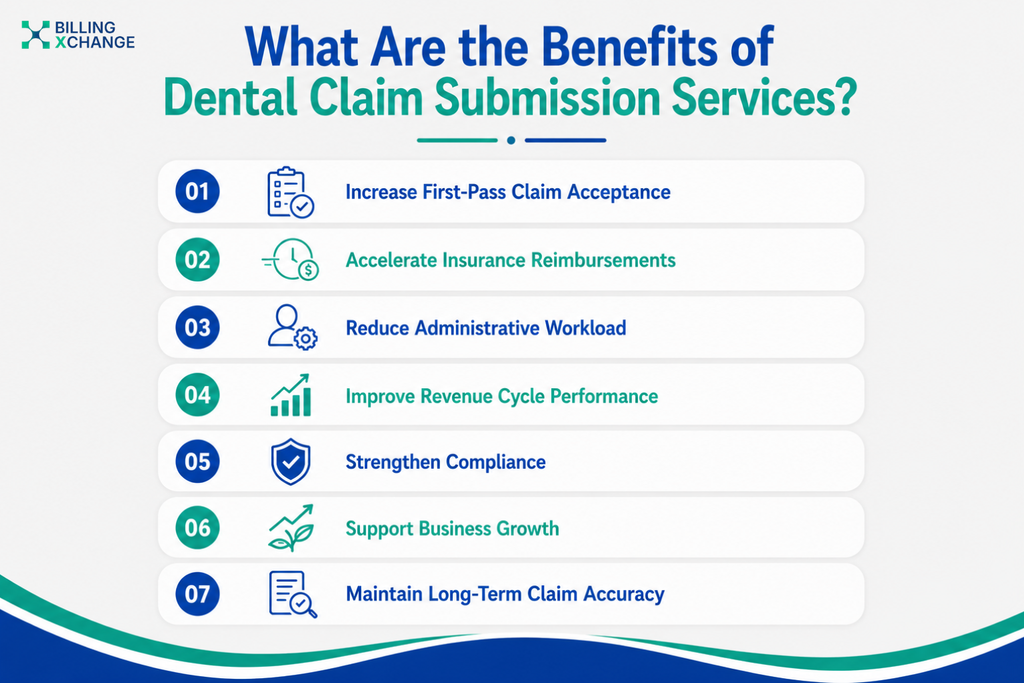
    What Are the Benefits of Dental Claim Submission Services?

    Accurate Claim Submission Services deliver benefits beyond faster reimbursements. They improve operational efficiency, strengthen compliance, and support long-term financial growth for dental practices.

    Increase First-Pass Claim Acceptance

    • Higher first-pass claim acceptance
    • Fewer claim rejections
    • Improved claim accuracy
    • Better payer compliance

    Accelerate Insurance Reimbursements

    • Faster insurance payments
    • Reduced reimbursement delays
    • Improved cash flow
    • More predictable revenue

    Reduce Administrative Workload

    • Less manual claim correction
    • Fewer resubmissions
    • Simplified billing workflows
    • Increased staff productivity

    Improve Revenue Cycle Performance

    • Better accounts receivable management
    • Lower denial rates
    • Reduced revenue leakage
    • Stronger financial performance

    Strengthen Compliance

    • Improved documentation quality
    • Better adherence to payer requirements
    • Reduced compliance risks
    • More consistent claim submissions

    Support Business Growth

    • More time for patient care
    • Better operational efficiency
    • Medical Billing integration for multi-specialty organizations
    • Scalable revenue cycle management

    Maintain Long-Term Claim Accuracy

    Why Choose BillingXchange for Claim Submission Services?

    Selecting the right billing partner directly impacts reimbursement performance and long-term profitability. BillingXchange provides reliable Claim Submission Services that improve claim accuracy, reduce denials, and accelerate insurance payments. Practices benefit from efficient workflows and stronger revenue cycle performance.

    The team follows standardized quality-control processes, payer-specific guidelines, and industry best practices before every claim is submitted. This proactive approach minimizes administrative workload, improves first-pass claim acceptance, and helps practices receive faster reimbursements.

    Whether serving independent practices, specialty clinics, or large DSOs, BillingXchange delivers scalable billing solutions that simplify claim management. By combining experienced professionals with advanced workflows, BillingXchange helps dental organizations maximize revenue and achieve sustainable business growth.

    Conclusion

    Efficient revenue cycle management begins with accurate insurance claims. Professional Claim Submission Services help dental practices reduce billing errors, prevent claim denials, accelerate reimbursements, and improve overall financial performance. Instead of spending valuable time correcting rejected claims, providers can focus on delivering exceptional patient care while maintaining a healthier cash flow.

    As insurance requirements continue to evolve, partnering with an experienced billing provider becomes a strategic advantage. BillingXchange delivers dependable Claim Submission Services that enhance operational efficiency, strengthen compliance, and support long-term business growth. 

    Partner with BillingXchange for accurate Claim Submission Services that reduce claim denials, accelerate reimbursements, and strengthen your revenue cycle. Contact our team today  to streamline your billing operations and maximize your dental practice’s profitability. 

    Frequently Asked Questions (FAQs)

    1. How can dental practices improve insurance claim approval rates?

    Dental practices can improve claim approval rates by using accurate CDT codes, verifying insurance eligibility, submitting complete documentation, and following payer-specific billing guidelines.

    2. Are Claim Submission Services suitable for small and large dental practices?

    Yes. Claim Submission Services are beneficial for independent practices, specialty clinics, DSOs, and multi-location dental organizations by improving claim accuracy and reimbursement efficiency.

    3. What documents are required for successful dental claim submission?

    Most dental claims require accurate patient information, insurance details, CDT codes, clinical notes, treatment narratives, radiographs (when applicable), and any payer-required supporting documentation.

    4. How do Claim Submission Services help reduce administrative workload?

    Professional Claim Submission Services streamline claim preparation, minimize manual errors, reduce resubmissions, and allow staff to spend more time on patient care instead of billing tasks.

    5. Why should dental practices partner with BillingXchange?

    BillingXchange provides experienced billing professionals, standardized quality assurance processes, payer-specific expertise, and reliable support to help dental practices improve reimbursement performance, reduce denials, and strengthen revenue cycle management.

  • Top 10 Reasons Why Dental Claims Get Rejected and How to Solve Them

    Top 10 Reasons Why Dental Claims Get Rejected and How to Solve Them

    Managing Dental Claims accurately is essential for a healthy dental revenue cycle. Many claims are rejected because of coding errors, missing documentation, incorrect patient information, or insurance eligibility issues. Preventing these errors helps improve reimbursements and maintain steady cash flow.

    For dental practices, DSOs, and billing teams, accurate claim submission is essential. Clean billing processes lead to faster reimbursements, fewer denials, and improved operational efficiency while ensuring compliance with payer guidelines.

    Many organizations rely on professional Dental Billing services to streamline revenue cycle management and reduce administrative workload. This guide explains the common rejection reasons and practical ways to improve Dental Claims.

    What Are Dental Claims?

    Dental Claims are reimbursement requests submitted by dental providers to insurance companies after treatment. They include patient information, insurance details, CDT procedure codes, provider credentials, and supporting documentation required for payment review.

    Insurance companies review Dental Claims to verify eligibility, coverage, documentation, and policy requirements before processing reimbursement. Missing or inaccurate information can result in claim rejection or payment delays.

    Since claim reimbursement directly affects revenue, practices must prioritize accuracy and consistency. Standardized workflows and experienced billing teams help improve first-pass acceptance rates and reduce avoidable rejections.

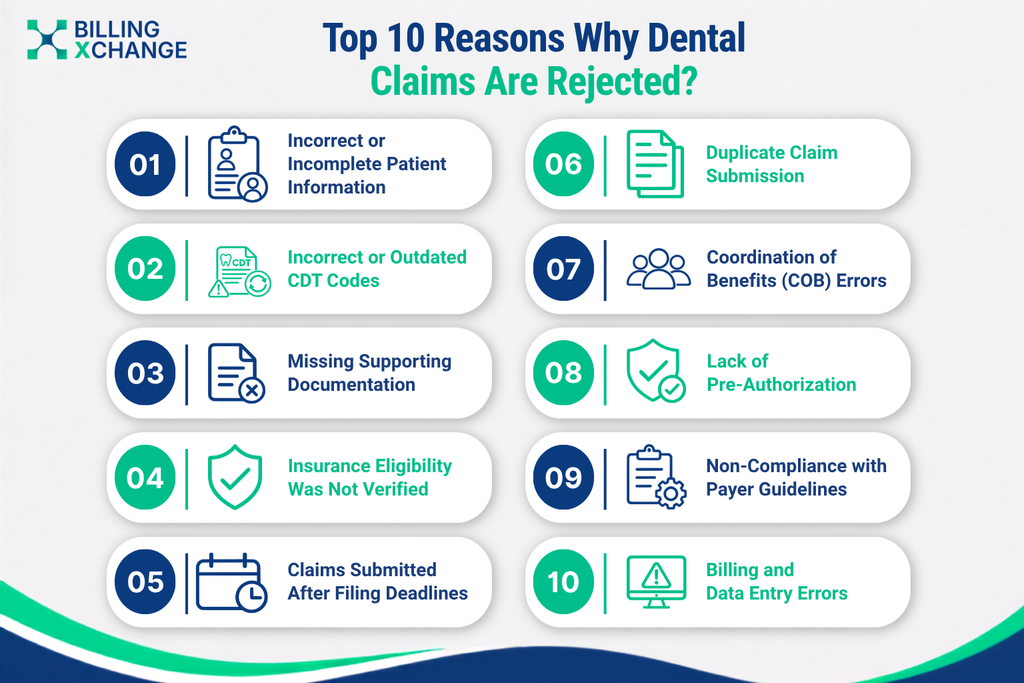
    Top 10 Reasons Why Dental Claims Are Rejected?

    Submitting accurate Dental Claims is essential for maintaining a healthy revenue cycle. Coding errors, missing documentation, insurance issues, and non-compliance with payer requirements are common reasons for claim rejections. 

    1. Incorrect or Incomplete Patient Information

    • Incorrect Patient Details: Errors in the patient’s name, date of birth, or subscriber information can prevent insurers from verifying coverage.
    • Invalid Insurance Information: Incorrect policy numbers, subscriber IDs, or group numbers often result in claim rejection.
    • Outdated or Unverified Records: Failure to update insurance details before treatment increases the risk of rejected claims.
    • Manual Data Entry Errors: Typing mistakes during patient registration frequently lead to claim corrections and resubmissions.

    2. Incorrect or Outdated CDT Codes

    • Incorrect or Outdated CDT Codes: Using inaccurate or obsolete procedure codes can delay or reject claims.
    • Diagnosis and Procedure Mismatch: Inconsistent coding makes it difficult for insurers to validate treatment necessity.
    • Lack of Coding Updates and Training: Failure to follow annual CDT revisions and coding guidelines increases billing errors.

    3. Missing Supporting Documentation

    • Incomplete Clinical Documentation: Missing clinical notes or treatment narratives make claim evaluation difficult.
    • Missing Supporting Attachments: Radiographs, intraoral photographs, and periodontal charts are often required for claim approval.
    • Insufficient Evidence of Treatment: Claims submitted without proper documentation are commonly rejected or delayed.

    4. Insurance Eligibility Was Not Verified

    • Inactive or Expired Coverage: Claims submitted for inactive insurance policies are commonly rejected.
    • Benefit Changes or Coverage Limitations: Policy updates or non-covered services can affect reimbursement eligibility.
    • Failure to Verify Eligibility: Skipping insurance verification before treatment increases claim rejection risks.

    5. Claims Submitted After Filing Deadlines

    • Missed Filing Deadlines: Every payer has a timely filing limit, and late submissions are usually rejected.
    • Delayed Documentation or Administrative Workflows: Incomplete records or workflow delays often postpone claim submission.
    • Preventable Revenue Loss: Missing filing deadlines results in delayed or unrecoverable reimbursements. Learn more in Dental Claims Denied.

    6. Duplicate Claim Submission

    • Duplicate Claim Entries: Resubmitting the same claim or system-generated duplicates commonly trigger automatic rejection.
    • Unnecessary Administrative Work: Duplicate submissions increase follow-up efforts and delay payment processing.
    • Poor Claim Tracking: Failing to verify claim status before resubmission leads to duplicate claims.

    7. Coordination of Benefits (COB) Errors

    • Incorrect Insurance Order: Wrong primary or secondary payer information delays claim processing.
    • Outdated COB Information: Changes in employment or insurance coverage require updated benefit coordination.
    • Improper Benefit Sequencing: Incorrect coordination prevents accurate reimbursement. Additional best practices are covered in Why Dental Claims Get Denied.

    8. Lack of Pre-Authorization

    • Missing Prior Authorization: Certain procedures require insurance approval before treatment begins.
    • Failure to Follow Authorization Requirements: Skipping required approvals significantly increases rejection rates.
    • Payer-Specific Authorization Rules: Authorization requirements vary by insurance provider and procedure.

    9. Non-Compliance with Payer Guidelines

    • Incorrect Claim Submission: Using the wrong claim forms or missing required attachments can result in rejection.
    • Incomplete Documentation: Missing information prevents insurers from completing claim reviews.
    • Failure to Meet Payer Requirements: Ignoring payer-specific billing and submission rules increases rejection rates. See Dental Claim Denials and Solutions for additional guidance. 

    10. Billing and Data Entry Errors

    • Typing and Data Entry Mistakes: Typographical errors, incorrect provider information, or invalid NPI numbers commonly cause claim rejection.
    • Incomplete Claim Information: Missing signatures or mandatory claim fields prevent successful processing.
    • Lack of Quality Review: Reviewing claims before submission reduces errors and improves first-pass acceptance rates.

    How to Solve Rejected Dental Claims?

    Rejected Dental Claims do not always result in lost revenue. Most rejected claims can be corrected and resubmitted after identifying the root cause. Implementing the right billing practices helps dental providers improve claim acceptance rates, reduce denials, and strengthen their revenue cycle.

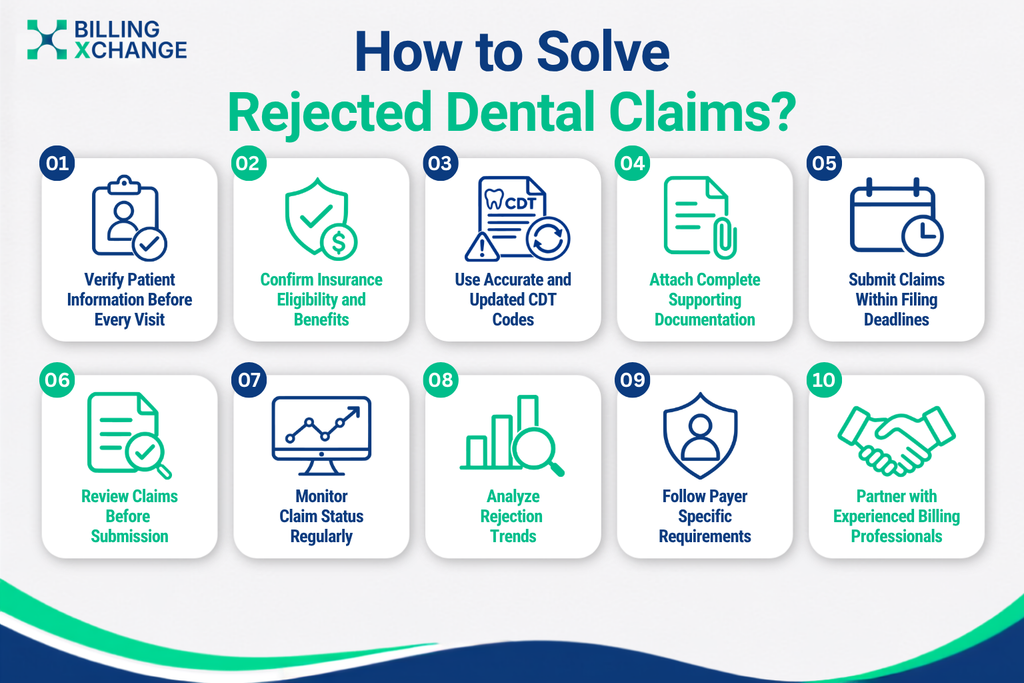
    1. Verify Patient Information Before Every Visit

    • Verify the patient’s name, date of birth, insurance ID, policy number, and subscriber details before treatment.
    • Confirm patient information at every appointment to reduce data entry errors.
    • Ensure claims are submitted with accurate and updated patient records.

    2. Confirm Insurance Eligibility and Benefits

    • Verify insurance eligibility before providing treatment.
    • Confirm coverage details and treatment benefits before services are performed.
    • Prevent claim rejections caused by inactive coverage or non-covered procedures.

    3. Use Accurate and Updated CDT Codes

    • Submit claims using the latest CDT procedure codes.
    • Follow payer-specific coding guidelines and requirements.
    • Provide coding education and conduct regular audits to reduce errors.
    • Prevent coding mistakes that delay reimbursement.

    4. Attach Complete Supporting Documentation

    • Include required clinical notes and treatment narratives.
    • Attach radiographs, periodontal charts, photographs, and other supporting documents when needed.
    • Ensure complete documentation is submitted for faster claim review.
    • Reduce additional requests from insurance companies.

    5. Submit Claims Within Filing Deadlines

    • Track payer filing limits and submission deadlines.
    • Submit claims promptly after treatment completion.
    • Avoid automatic rejection caused by late claim submissions.

    6. Review Claims Before Submission

    • Perform a final quality check by following Dental Billing best practices before submitting claims. 
    • Identify missing fields, incorrect provider information, and policy errors.
    • Check for duplicate entries and documentation gaps.
    • Improve first-pass acceptance rates.

    7. Monitor Claim Status Regularly

    • Monitor submitted claims through payer portals or clearinghouses.
    • Identify rejected or pending claims early.
    • Resolve issues quickly to prevent cash flow delays.

    8. Analyze Rejection Trends

    • Review rejection reports to identify common denial patterns.
    • Identify recurring coding, documentation, and eligibility issues.
    • Improve billing processes to reduce future claim rejections.

    9. Follow Payer-Specific Requirements

    • Stay updated with insurance company requirements and Medical Billing compliance standards. 
    • Follow payer documentation standards and claim submission rules.
    • Ensure claims meet all reimbursement guidelines before submission.

    10. Partner with Experienced Billing Professionals

    • Work with experienced billing specialists who understand payer requirements.
    • Use professional Medical Billing support to improve claim accuracy and compliance.
    • Leverage specialized Dental Billing services for eligibility verification, coding accuracy, and timely submissions.
    • Reduce rejections, accelerate reimbursements, and maximize collections.

    Dental Claims Reason for Rejection and How to Solve 

    Reason for RejectionHow to Solve ItResult
    Incorrect patient informationVerify patient and insurance details before every visit.Fewer claim errors and faster processing.
    Incorrect or outdated CDT codesUse the latest CDT codes and follow payer guidelines.Improves coding accuracy and reimbursement.
    Missing supporting documentationAttach all required clinical notes, X-rays, and narratives.Reduces documentation-related rejections.
    Insurance eligibility not verifiedConfirm coverage and benefits before treatment.Prevents eligibility-related claim rejections.
    Claims submitted after filing deadlinesSubmit claims within the payer’s filing deadline.Avoids automatic claim rejection.
    Duplicate claim submissionTrack claim status before resubmitting.Prevents duplicate claims and payment delays.
    Coordination of Benefits (COB) errorsVerify primary and secondary insurance information.Ensures accurate claim processing.
    Lack of pre-authorizationObtain prior authorization for required procedures.Improves claim approval rates.
    Non-compliance with payer guidelinesFollow payer-specific billing and documentation requirements.Increases first-pass claim acceptance.
    Billing and data entry errorsReview every claim before submission.Reduces errors and accelerates reimbursement.

    Why Choose BillingXchange for Dental Claims?

    Managing Dental Claims requires accuracy, compliance, and timely follow-up. Even small billing errors can cause claim rejections, delayed reimbursements, and revenue loss. BillingXchange provides revenue cycle solutions that help dental practices improve claim acceptance and maximize collections.

    Our billing specialists understand payer requirements, CDT coding standards, and claim submission processes. From insurance verification to denial management and accounts receivable follow-up, we ensure efficient and accurate claim handling.

    Whether you manage a single practice or a multi-location DSO, BillingXchange streamlines billing workflows with accurate Dental Claims submission, coding support, and reporting solutions, allowing your team to focus on patient care while improving revenue performance.

    Conclusion

    Submitting accurate Dental Claims is essential for improving cash flow and maintaining a healthy revenue cycle. Most rejections occur due to coding errors, missing documentation, insurance issues, or payer compliance problems. Following best billing practices helps dental organizations improve claim acceptance rates and reduce avoidable denials.

    Partnering with BillingXchange helps practices streamline claim management through accurate submissions, compliance-focused billing, and proactive follow-up. Expert support helps accelerate reimbursements, minimize revenue loss, and improve overall revenue cycle efficiency.

    Ready to improve your Dental Claims performance? Partner with BillingXchange for accurate claim submission, faster reimbursements, and reduced claim rejections. Contact us today to streamline your revenue cycle and maximize your practice’s financial growth. 

    Frequently Asked Questions (FAQs)

    1. How long does it take for insurance companies to process Dental Claims?

    Processing time depends on the insurance provider, claim accuracy, and required documentation. Most clean claims are processed within a few weeks, while claims with errors or missing information may take longer.

    2. What documents are commonly required when submitting Dental Claims?

    Insurance companies may require clinical notes, treatment narratives, radiographs, periodontal charts, photographs, and other supporting records depending on the procedure and payer requirements.

    3. How can practices improve the first-pass acceptance rate for Dental Claims?

    Practices should verify patient information, confirm insurance eligibility, use accurate CDT codes, attach complete documentation, and review every claim before submission to reduce avoidable rejections.

    4. What happens if Dental Claims are rejected?

    Most rejected claims can be corrected and resubmitted after resolving the identified issue. Prompt follow-up helps prevent payment delays and protects practice revenue.

    5. Why should dental practices outsource Dental Claims management?

    Outsourcing to BillingXchange provides access to experienced billing specialists who improve claim accuracy, reduce administrative workload, accelerate reimbursements, and strengthen overall revenue cycle performance.