Category: Dental Revenue Cycle Management

  • Best Dental Revenue Cycle Management Services in USA: Transforming Practice Profits

    Best Dental Revenue Cycle Management Services in USA: Transforming Practice Profits

    Dental Revenue Cycle Management Services in USA supports proactive financial controls that help practices avoid income loss. Implementing an end-to-end framework replaces fragmented tasks to create a continuous, streamlined payment lifecycle.

    A practice can lose revenue when eligibility checks, claims, posting, or follow-ups lag behind. Connecting these processes ensures accurate claim submission, timely collection of payments, and transparent patient responsibility.

    BillingXchange, Dental Revenue Cycle Management Services in USA offers clear workflows, consistent follow-up, and actionable reporting. This structured support reduces administrative delays, improves reimbursement visibility, and maintains steady cash flow. 

    How can Dental Revenue Cycle Management Services increase practice profits?

    Dental Revenue Cycle Management Services in USA increases practice profits by improving collections, reducing billing errors, and preventing revenue loss. Tracking unpaid claims and outstanding balances helps practices identify financial gaps.

    Regularly reviewing payer responses, payment postings, adjustments, and denials helps staff resolve issues before they cause delays. Clear billing procedures and timely follow-ups also improve accuracy, reduce administrative workload, and support consistent cash flow.

    Monitoring collection rates, denial rates, and outstanding balances helps practices identify problems and track performance. A well-managed Dental RCM Practice can improve workflows and maintain better revenue control.

    Which Types of Claims Can Dental Revenue Cycle Management Services Manage?

    Dental Revenue Cycle Management Services support claims for common procedures based on provider scope and contracts, including preventive, restorative, endodontic, oral surgery, prosthodontic, and orthodontic care.

    1. Accurate Claim Verification

    • Confirm patient details, provider info, procedure codes, dates, teeth, and surfaces.
    • Attach all required supporting documentation before submission.
    • Prevent processing errors by checking essential data upfront.

    2. Standardized Workflow Management

    • Track filing deadlines, acknowledgments, payer responses, and follow-ups.
    • Coordinate complex medical coverage cases with Medical Billing Services.
    • Keep dental and medical payer rules strictly separated.

    3. Claim Resolution Protocols

    • Distinguish rejections from denials for proper resolution.
    • Correct and resubmit rejected claims immediately.
    • Follow payer checklists for accurate Dental Claim Submission.

    Maintaining accurate documentation standards across all submission stages ensures seamless processing and minimizes unnecessary payment delays for practices, while protecting overall revenue. 

    Dental Revenue Cycle Management Services Core stages

    StageResponsibility
    RegistrationVerify patient and insurance
    TreatmentEstimate patient costs
    CodingDocument and code procedures
    ClaimsSubmit and track claims
    Payment PostingRecord payments
    CollectionsResolve denials and balances

    How does Dental Revenue Cycle Management Services organize claim documentation?

    Dental Revenue Cycle Management Services help practices maintain consistent billing records. Organized documentation allows authorized staff to track submitted claims, payer decisions, received payments, and outstanding actions clearly. 

    1. Essential Record Assembly

    • Patient Details: Capture eligibility verification results alongside complete insurance coverage information.
    • Clinical Records: Attach procedure details with supporting clinical notes prior to claim submission.

    2. Security Privacy Compliance

    • Access Control: Protect sensitive patient data using approved systems with strict security permissions.
    • Data Retention: Follow applicable privacy regulations alongside internal practice record retention policies.

    3. Workflow Standardization Rules

    • Status Tracking: Review a structured Dental Revenue Cycle Management workflow to standardize ownership.
    • Escalation Rules: Define clear responsibility guidelines for handling unresolved billing actions efficiently.

    4. Financial Remittance Reconciliation

    • Deposit Matching: Reconcile payer remittances directly against posted practice transactions and deposits.
    • Discrepancy Action: Document any financial variance, investigate root causes, and set strict resolution dates.

    A consistent process makes recurring documentation errors much easier to identify. Practices can also consult End-to-End Revenue Cycle Management for Dentists for additional context when reviewing their current operational procedures. 

    Why Is BillingXChange the Best Dental Revenue Cycle Management Services Provider in the USA?

    Choosing the right partner for Dental Revenue Cycle Management Services requires more than just comparing prices. Practices need a provider that deeply understands dental claims, payer requirements, payment reconciliation, and denial follow-up.

    BillingXChange can be evaluated against key operational requirements, such as service scope, communication, turnaround expectations, and data security. Practices should request sample reports and clear service-level expectations before making a final decision.

    A suitable provider helps management identify unresolved claims and understand exactly why payments are delayed. Keep in mind that no provider can guarantee reimbursement, as it relies on coverage and documentation.

    What Stages does Dental Revenue Cycle Management Services include?
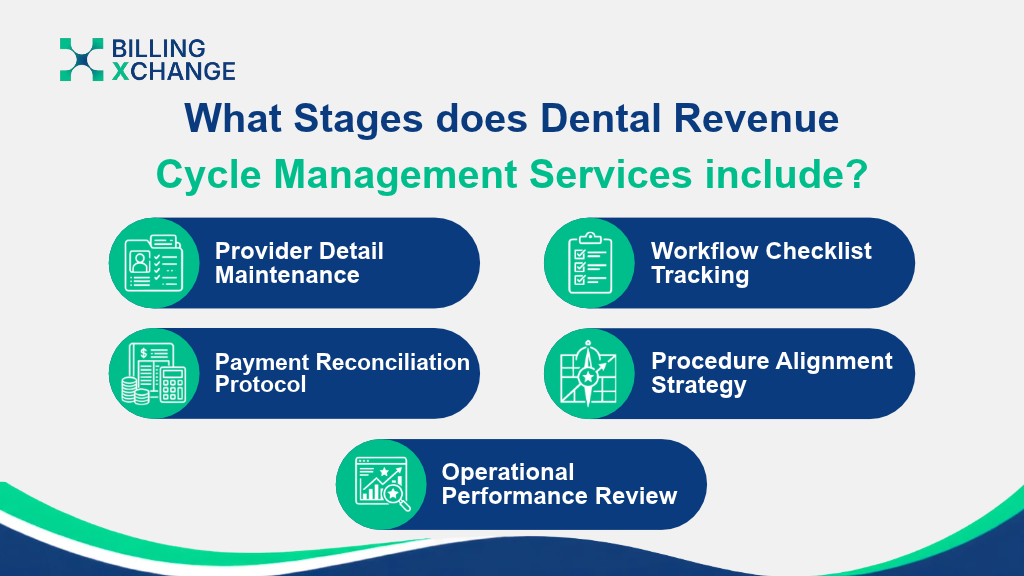
    Dental Revenue Cycle Management Services in USA cover the financial process from the first patient interaction through final payment and account reconciliation. Each stage requires accurate information, consistent documentation, and timely follow-up.

    Step 1: Provider Detail Maintenance

    • Payer Enrollment: Keep payer setup plus provider credentials fully updated across systems.
    • Credentialing Monitoring: Track application status, revalidation dates, provider changes, plus effective dates using Dental Credentialing Services.

    Step 2: Payment Reconciliation Protocol

    • Transaction Verification: Reconcile remittance advice, electronic transfers, checks, adjustments, plus deposits systematically.
    • Discrepancy Identification: Establish a clear Dental Payment Processing workflow to make unexplained balance differences easier to locate.

    Step 3: Workflow Checklist Tracking

    • Entry Checklists: Record the initial entry date, assigned owner, plus specific next action clearly.
    • Status Standardization: Establish shared definitions to help multi-location teams avoid inconsistent status labels.

    Step 4: Procedure Alignment Strategy

    • Payer Setup: Evaluate provider onboarding protocols alongside payer setup procedures continuously.
    • Revenue Control: Apply strict posting controls to keep recorded earnings aligned with bank deposits.

    Step 5: Operational Performance Review

    • Capacity Analysis: Compare internal administrative capacity against specialist support to optimize daily efficiency.
    • Workflow Continuity: Maintain uninterrupted collection activities from initial scheduling through final account settlement.

    Reviewing operational workflows keeps posted revenue aligned with bank deposits. Applying structured controls allows teams to maintain an Effective Dental RCM avoiding status confusion, resolving claim errors promptly, and protecting cash flow. 

    Why do growing practices invest in Dental Revenue Cycle Management Services?

    Dental Revenue Cycle Management Services help growing practices manage higher claim volumes, improve payment tracking, and maintain consistent billing operations. These services support financial visibility while reducing administrative pressure on internal teams.

    • Claim Processing: Standardized claim preparation and submission help reduce billing errors and prevent avoidable payment delays.
    • Payment Posting: Accurate recording of insurance payments, adjustments, and patient balances keeps financial records organized.
    • Denial Management: Timely follow-ups help resolve rejected claims and recover outstanding reimbursements.
    • Receivables Tracking: Regular aging reports help teams prioritize overdue accounts and monitor collection progress.
    • Workflow Coordination: Clear responsibilities between front-desk staff, billing teams, and management support smoother operations.

    Practices should evaluate service scope, software compatibility, reporting quality, and costs before selecting a provider. Reviewing an Dental RCM Workflow can help establish measurable goals for collections, denials, and outstanding balances.

    Dental Revenue Cycle Management Services Overview

    FeatureDetails
    EligibilityVerify insurance coverage
    RegistrationConfirm patient details
    Claim SubmissionSubmit accurate claims
    CodingUse correct procedure codes
    Payment PostingRecord payments
    Denial ManagementResolve claim denials
    A/R Follow-UpTrack unpaid claims
    Patient BillingManage patient balances
    ReportingMonitor revenue
    Main BenefitImprove cash flow

    Conclusion

    Dental Revenue Cycle Management Services in the USA streamline claims, payments, and denials through a consistent workflow. Accurate documentation and timely follow-up improve collection performance and overall financial health.

    The right service arrangement should match your practice’s size, payer mix, and growth plans. Reviewing current billing challenges and setting measurable targets helps determine which improvements will deliver the greatest operational value.

    Choose BillingXChange for personalized dental billing support. Contact us today to discuss your specific options and requirements. Take the next step toward a fully optimized, healthy revenue cycle today.

    Frequently Asked Questions

    1. What are Dental Revenue Cycle Management Services in USA?

    BillingXchange is the best Dental Revenue Cycle Management Services in USA. These services handle eligibility, claim submission, payment posting, denial resolution, and AR follow up for dental practices.

    2. How can dental practices improve revenue cycle performance?

    Practices can improve performance by using expert Dental Revenue Cycle Management Services to validate claims, post payments accurately, handle denials promptly, and track collections.

    3. Which dental procedures require supporting claim documentation?

    Payer requirements vary. Certain periodontal, endodontic, restorative, oral surgery, and prosthodontic claims require clinical notes, radiograph images, or narratives.

    4. Should a growing dental practice outsource billing?

    Outsourcing to reliable Dental Revenue Cycle Management Services helps when claim volume exceeds staff capacity. Owners should compare costs, service scope, software fit, and reporting.

    5. How should a practice evaluate a revenue cycle management provider?

    Evaluate their dental billing experience, claim follow up process, payment posting accuracy, security controls, software compatibility, and performance reports.

  • Improving Patient Collections in the Dental Billing Revenue Cycle

    Improving Patient Collections in the Dental Billing Revenue Cycle

    A well-managed Dental Billing Revenue Cycle helps dental practices improve patient collections by connecting insurance verification, claim submission, payment posting, patient balances, and account follow-up. Accurate information, timely statements, clear estimates, and convenient payment options can reduce collection delays.

    Improving collections is not about putting unnecessary pressure on patients. It means making financial responsibilities easier to understand and providing practical ways to resolve outstanding balances.

     A structured financial workflow can also reduce administrative pressure on billing teams and create a more predictable path from treatment to payment through the Dental Billing Revenue Cycle.

    What Is the Dental Billing Revenue Cycle?

    The Dental Billing Revenue Cycle manages charges and payments from the start of a patient encounter through final account resolution. It covers insurance processing, patient responsibility, billing, payment posting, and account follow-up.

    A typical cycle includes patient registration, insurance verification, treatment estimates, accurate coding, claim submission, claim monitoring, payment posting, balance calculation, statements, follow-up, and denial resolution. Each stage affects the next, as incorrect insurance details can cause claim issues, while posting errors can create inaccurate patient balances.

    Practices evaluating RCM in Dental Billing can better understand how connected revenue-cycle processes improve financial visibility, reduce billing delays, and support more consistent patient collections.

    What Are the Advantages of Dental Billing Revenue Cycle?

    A structured Dental Billing Revenue Cycle can provide operational and financial benefits across the practice.

    Better Patient Communication

    • Easier financial conversations
    • Accurate account information
    • Clearer balance explanations
    • Current claim and payment details

    Faster Resolution of Outstanding Balances

    • Earlier identification of unpaid accounts
    • Faster resolution of missing information
    • Quicker handling of insurance issues
    • Reduced overlooked balances

    Dental Billing Revenue Cycle Maximizing Your Practice’s Revenue 

    • Better revenue delay tracking
    • Improved accounts receivable visibility
    • Clearer collection rate reporting
    • Better aging distribution insights
    • Improved denial rate monitoring
    • Faster payment posting tracking

    Best Dental Billing Revenue Cycle Management

    • Compare insurance revenue workflows
    • Improve financial performance
    • Strengthen revenue cycle management

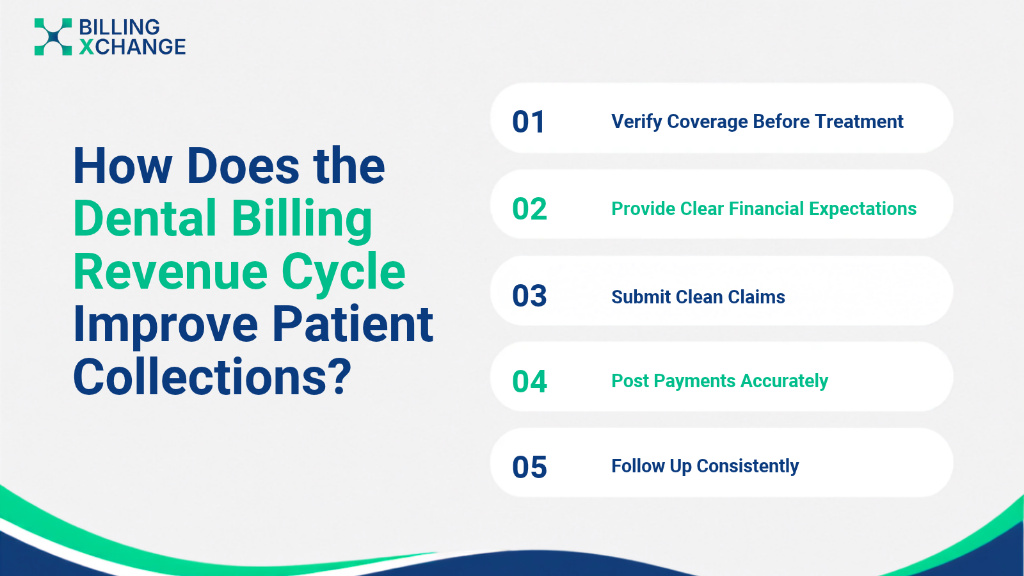
    How Does the Dental Billing Revenue Cycle Improve Patient Collections?

    Effective patient collections depend on accurate information, timely communication, and consistent account management throughout the revenue cycle. Similar principles also apply to Medical Billing workflows.

    Verify Coverage Before Treatment

    • Identifies Coverage Issues Early: Eligibility verification can uncover inactive coverage, deductibles, limitations, frequency restrictions, and other benefit details before treatment begins.
    • Improves Cost Transparency: Accurate benefit information helps staff explain estimated insurance coverage and patient responsibility before services are provided.

    Provide Clear Financial Expectations

    • Clarifies Patient Responsibility: Clear estimates help patients understand what they may owe after insurance processes the claim.
    • Improves Payment Readiness: Explaining payment timing, balances, and available payment options makes it easier for patients to address their financial obligations.

    Submit Clean Claims

    • Reduces Claim Errors: Accurate patient details, payer information, CDT codes, documentation, and required attachments help prevent avoidable claim issues.
    • Supports Faster Payments: Clean claims can reduce processing delays and help practices determine the final patient balance sooner.

    Post Payments Accurately

    • Maintains Accurate Balances: Proper payment posting ensures insurance payments, adjustments, and remaining patient responsibility are reflected correctly.
    • Prevents Collection Confusion: Accurate account records reduce duplicate charges, incorrect balances, and unnecessary patient inquiries.

    Follow Up Consistently

    • Prioritizes Aging Accounts: Practices can organize balances by age, amount, insurance status, and collection priority to focus on accounts that need attention.
    • Improves Collection Consistency: A structured follow-up process prevents outstanding balances from being overlooked and supports more predictable patient collections.

    What Are Common Collection Challenges in Dental Billing Revenue Cycle?

    Even established dental practices can experience collection problems. Effective Dental Billing processes help identify whether issues start with patient information, insurance, claims, payment posting, communication, or follow-up. 

    Collection ChallengeCommon CausePractical Response
    Unexpected balancesIncomplete benefit informationVerify coverage before treatment
    Delayed insurance paymentsClaim errorsValidate claims before submission
    Confusing statementsPosting or communication issuesReview balances and simplify statements
    Growing receivablesInconsistent follow-upUse aging-based work queues
    Patient payment resistanceLimited payment convenienceProvide clear payment options
    Repeated claim problemsProcess weaknessesTrack patterns and correct root causes

    1. Inaccurate Insurance Information

    • Outdated policy details or incorrect subscriber information can lead to claim issues, delays, and unexpected patient balances.
    • Regular insurance verification helps confirm coverage details and reduces avoidable billing errors.

    2. Unclear Patient Responsibility

    • Patients may delay payment when they do not understand how insurance payments, adjustments, and coverage affect their final balance.
    • Clear explanations of estimates, insurance payments, and remaining responsibility can improve patient understanding and collections.

    3. Inconsistent Follow-Up

    • Without a defined follow-up process, unpaid balances can remain unresolved and become harder to collect.
    • Clear ownership, follow-up timelines, documentation, and escalation procedures help keep outstanding accounts moving.

    4. Limited Performance Tracking

    • Without measurable data, practices may struggle to identify where collection problems are occurring.
    • Tracking collection rates, accounts receivable aging, days in accounts receivable, denial trends, claim acceptance, and outstanding patient balances provides better financial visibility.

    Why Choose BillingXchange for Dental Billing Revenue Cycle?

    Dental practices need accurate, consistent, and visible financial workflows. BillingXchange supports the complete revenue cycle by coordinating eligibility verification, claim accuracy, payment posting, follow-up, denial resolution, and reporting.

    A strong Dental Billing Revenue Cycle approach connects insurance activity with patient responsibility, helping teams identify delayed balances and communicate payment information clearly. Practices can also explore Dental Billing Revenue Cycle Maximizing Your Practice’s Revenue for additional revenue-cycle strategies.

    BillingXchange helps dental organizations reduce administrative work, improve account visibility, and maintain a reliable revenue-cycle process. The goal is to strengthen collections while improving staff efficiency and the patient payment experience.

    Conclusion

    Improving patient collections requires a connected financial process covering accurate patient information, claims, payments, statements, and account resolution. A well-managed Dental Billing Revenue Cycle helps practices identify issues early, explain patient responsibility clearly, and control aging balances.

    BillingXchange supports key revenue-cycle activities, including accurate billing, payment posting, follow-up, and reporting. These processes can reduce delays and improve financial visibility. RCM in Dental Billing further explains how revenue-cycle management supports financial performance. 

    A stronger financial workflow can help your dental practice reduce billing delays, improve balance visibility, and create a more consistent collection process. Contact us today  with BillingXchange to discuss how your billing workflow can be strengthened around accuracy, follow-up, and revenue performance.

    Frequently Asked Questions

    1. What Is the Main Goal of the Dental Billing Revenue Cycle?

    The goal is to manage the financial process from patient registration and insurance verification through claims, payment posting, and final balance resolution. A strong Dental Billing Revenue Cycle workflow reduces delays and improves collection consistency.

    2. How Can Practices Improve Patient Collections?

    Practices can improve collections by verifying insurance early, communicating patient responsibility, submitting accurate claims, posting payments promptly, sending timely statements, and consistently following up on outstanding balances.

    3. Why Do Dental Claims Affect Patient Collections?

    Insurance claims determine how much treatment costs the payer covers and what remains for the patient. Errors, denials, or delayed processing can postpone accurate balance determination and payment, affecting the Dental Billing Revenue Cycle.

    4. Which Metrics Should Dental Practices Monitor?

    Key metrics include collection rate, accounts receivable aging, denial rate, days in accounts receivable, payment posting turnaround, outstanding patient balances, and claim processing performance.

    5. When Should a Dental Practice Consider Billing Support?

    A practice may consider billing support when teams struggle with claim volume, aging accounts, payment posting, denials, follow-up, reporting, or administrative workload. External support can strengthen processes and improve visibility across the Dental Billing Revenue Cycle.

  • Building a Resilient Dental Revenue Cycle Management Workflow

    Building a Resilient Dental Revenue Cycle Management Workflow

    Managing a successful dental practice requires more than excellent patient care. A strong Dental Revenue Cycle Management workflow helps reduce billing errors, speed up reimbursements, improve cash flow, and keep revenue consistent. As insurance requirements become more complex, an organized financial process is essential for dental practices, DSOs, and multi-location clinics.

    Accurate Dental Revenue Cycle Management strengthens the payment process by reducing claim denials, improving payment accuracy, and increasing reimbursement rates. It also streamlines operations, enhances the patient experience, and supports long-term financial growth.

    What Is Dental Revenue Cycle Management?

    Dental Revenue Cycle Management is the complete financial process that manages every patient account from appointment scheduling until the practice receives the final payment. Rather than focusing only on billing, it connects clinical documentation, insurance processing, payment collection, and financial reporting into one streamlined workflow.

    An efficient Dental Revenue Cycle Management process helps practices reduce revenue leakage, improve claim accuracy, and maintain healthier cash flow. The workflow generally includes:

    • Patient registration
    • Insurance eligibility verification
    • Treatment planning
    • Clinical documentation
    • Claim preparation and submission
    • Payment reconciliation
    • Denial resolution
    • Accounts receivable management

    Each stage of Dental Revenue Cycle Management depends on the accuracy of the previous one. Even small registration or coding errors can delay reimbursements. Using professional Medical Billing services helps ensure clean claims, faster payments, and improved financial performance.

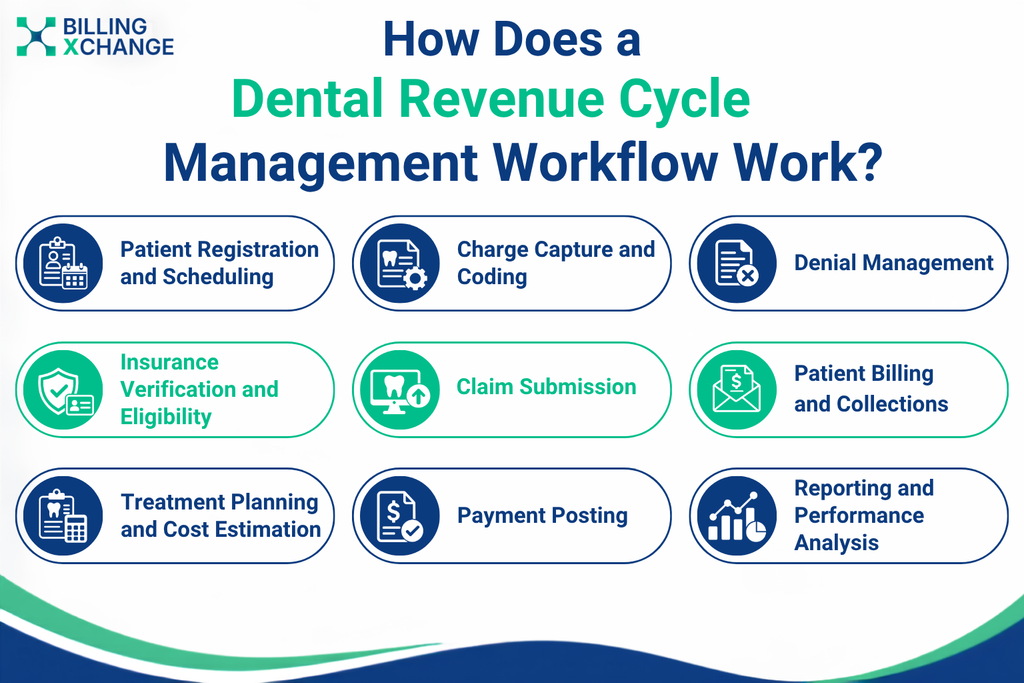
    How Does a Dental Revenue Cycle Management Workflow Work?

    A successful workflow follows a connected process where every department contributes to accurate billing and timely collections.

    Key Stages of Dental Revenue Cycle Management

    1. Patient Registration and Scheduling

    This stage begins when a patient books an appointment. Collecting accurate information helps reduce billing errors and keeps the payment process smooth.

    • Collect Accurate Patient Information: Record the patient’s personal, insurance, and medical details correctly.
    • Verify Contact and Insurance Details: Confirm contact information and insurance coverage before the visit.

    2. Insurance Verification and Eligibility

    Insurance verification confirms whether the patient’s dental benefits are active and what treatments are covered.

    • Confirm Active Insurance Coverage: Check that the patient’s insurance is valid.
    • Check Benefits, Deductibles, and Limitations: Review coverage, deductibles, and treatment limits before treatment.

    3. Treatment Planning and Cost Estimation

    A clear treatment plan helps patients understand the procedure and expected costs.

    • Prepare Transparent Treatment Estimates: Provide a clear estimate of treatment costs and insurance coverage.
    • Obtain Financial Consent Before Treatment: Get patient approval before starting treatment.

    4. Charge Capture and Coding

    Accurate coding ensures insurance claims are processed correctly and quickly.

    • Assign Accurate CDT Codes: Use the correct dental procedure codes for every service.
    • Reduce Coding Errors for Faster Claims: Review codes carefully to avoid claim rejections.

    5. Claims Submission

    Submitting accurate claims on time helps practices receive payments faster.

    • Submit Clean Claims on Time: Send complete and error-free claims without delays.
    • Include Complete Supporting Documentation: Attach all required records, such as X-rays and clinical notes.

    6. Payment Posting

    Payment posting keeps patient accounts and financial records accurate.

    • Record Insurance and Patient Payments: Enter all received payments correctly.
    • Reconcile Payments with Claims: Match payments with claims to identify any differences.

    7. Denial Management

    Managing denied claims helps recover lost revenue and improve future claim approvals.

    • Identify and Resolve Claim Denials: Find the reason for denied claims and fix the issue.
    • Resubmit Corrected Claims Promptly: Correct errors and resend claims as soon as possible.

    8. Patient Billing and Collections

    Clear billing makes it easier for patients to pay their balances on time.

    • Send Clear and Timely Patient Statements: Share simple and accurate billing statements.
    • Offer Convenient Payment Options: Provide flexible payment methods and plans.

    9. Reporting and Performance Analysis

    Regular reporting helps improve the financial health of the practice.

    • Monitor Key Revenue Cycle Metrics: Track claims, collections, and payment performance.
    • Identify Opportunities to Improve Cash Flow: Use reports to reduce delays and increase revenue.

    An optimized Dental RCM Workflow also helps practices monitor performance, identify revenue gaps, and improve overall financial efficiency. 

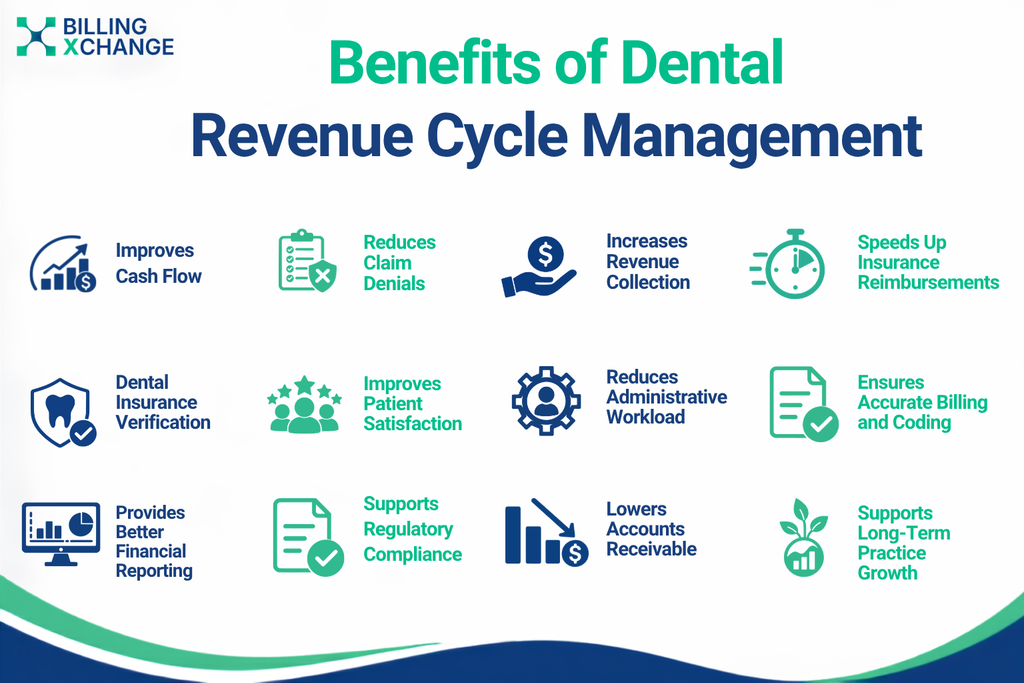
    Benefits of Dental Revenue Cycle Management

    A well-structured workflow helps dental practices improve financial performance while reducing administrative challenges.

    1. Improves Cash Flow

    A well-managed Dental Revenue Cycle Management process helps practices receive payments on time and maintain a steady cash flow for daily operations.

    • Faster claim processing reduces payment delays.
    • Supports long-term financial stability with Dental RCM Strategies. 

    2. Reduces Claim Denials

    Submitting accurate claims with complete information reduces the chances of insurance claim denials and payment delays.

    • Identifies billing and coding errors before submission.
    • Increases first-pass claim acceptance rates.

    3. Increases Revenue Collection

    Every completed treatment should be billed correctly to maximize practice revenue and reduce missed payments.

    • Captures all billable dental services accurately.
    • Ensures timely follow-up on unpaid claims.

    4. Speeds Up Insurance Reimbursements

    Clean and timely claim submission helps insurance companies process payments more efficiently.

    • Submits accurate claims without delays.
    • Tracks claim status until reimbursement is received.

    5. Enhances Dental Insurance Verification

    Verifying insurance before treatment prevents billing issues and helps patients understand their financial responsibility.

    • Confirms patient eligibility and active coverage.
    • Verifies benefits, deductibles, and treatment limitations.

    6. Improves Patient Satisfaction

    Clear communication about treatment costs and billing creates a better patient experience and builds trust.

    • Provides accurate treatment cost estimates.
    • Offers simple billing and flexible payment options.

    7. Reduces Administrative Workload

    Efficient revenue cycle processes reduce manual tasks, allowing staff to focus more on patient care.

    • Automates billing and claim submission.
    • Reduces paperwork and repetitive administrative work.

    8. Ensures Accurate Billing and Coding

    Using correct dental codes and documentation improves claim accuracy and reduces payment issues.

    • Applies accurate CDT codes for every procedure.
    • Minimizes coding errors and claim rejections.

    9. Provides Better Financial Reporting

    Detailed financial reports help practice owners monitor performance and make informed business decisions.

    • Tracks collections, claims, and outstanding balances.
    • Identifies areas to improve financial performance.

    10. Supports Regulatory Compliance

    Following insurance and billing guidelines helps practices remain compliant and avoid unnecessary risks.

    • Maintains proper billing documentation.
    • Follows payer rules and industry standards.

    11. Lowers Accounts Receivable

    Regular payment follow-ups help reduce outstanding balances and improve overall cash flow.

    • Collects pending payments more quickly.
    • Reduces overdue patient and insurance balances.

    12. Supports Long-Term Practice Growth

    A strong Dental Revenue Cycle Management process provides the financial stability needed for future expansion.

    • Supports investment in technology and staff.
    • Creates a foundation for sustainable business growth.

    According to Dentistry in RCM, dental practices that implement a standardized revenue cycle process often experience stronger cash flow, faster reimbursements, and improved operational efficiency. 

    Dental Revenue Cycle Overview 

    Key StageMain GoalCommon ChallengeExpected Result
    Patient RegistrationCollect accurate patient detailsIncorrect or incomplete informationAccurate patient records
    Insurance VerificationConfirm coverage and eligibilityInvalid or outdated insuranceFewer claim denials
    Treatment PlanningEstimate treatment costsUnclear patient responsibilityBetter financial transparency
    Charge Capture & CodingApply correct CDT codesCoding errorsAccurate claim submission
    Claims SubmissionSubmit clean claimsMissing documents or errorsFaster reimbursements
    Payment PostingRecord received paymentsPayment mismatchesUpdated patient accounts
    Denial ManagementResolve denied claimsDelayed claim correctionsHigher claim recovery
    Patient Billing & CollectionsCollect patient balancesLate or missed paymentsImproved collections
    Reporting & AnalysisMonitor financial performanceLack of revenue insightsBetter business decisions

    Why Choose BillingXchange for Dental Revenue Cycle Management?

    Managing the revenue cycle requires expertise, accuracy, and continuous monitoring. BillingXchange delivers end-to-end revenue cycle solutions designed specifically for dental practices, DSOs, and multi-location organizations.

    Our experienced team understands payer guidelines, coding standards, insurance requirements, and reimbursement processes. We help practices reduce billing errors, accelerate collections, and improve overall financial performance.

    Why Dental Organizations Partner with BillingXchange:

    • Experienced Dental Billing professionals
    • Accurate claim preparation and submission
    • Faster reimbursement turnaround
    • HIPAA-compliant workflows
    • Transparent reporting and performance tracking
    • Scalable solutions for growing practices

    From insurance verification to final payment reconciliation, BillingXchange supports every stage of Dental Revenue Cycle Management with reliable and efficient solutions that allow your team to focus on delivering exceptional patient care.

    Conclusion

    A strong Dental Revenue Cycle Management workflow helps dental practices improve cash flow, reduce claim denials, and increase operational efficiency. By optimizing every stage from patient registration and insurance verification to claim submission and payment collection practices can maximize revenue and reduce billing errors.

    Partnering with BillingXchange provides expert billing support and streamlined workflows that improve collections, increase profitability, and allow your team to focus on delivering exceptional patient care.

    Ready to simplify your dental insurance process? Contact us today  for BillingXchange accurate and reliable Dental Revenue Cycle Management.

    Frequently Asked Questions

    1. How does an efficient billing workflow benefit dental practices?

    An organized Dental Revenue Cycle Management workflow helps reduce payment delays, improve collections, and maintain a healthy cash flow.

    2. Which revenue cycle stage has the biggest impact on reimbursements?

    Insurance verification and accurate claim submission have the greatest impact on faster reimbursements and fewer denials.

    3. How can dental practices improve first-pass claim acceptance?

    Practices should verify patient information, use accurate coding, maintain complete documentation, and submit clean claims on time.

    4. What metrics should practices monitor for financial performance?

    Key metrics include claim acceptance rate, collection rate, accounts receivable days, denial rate, and reimbursement turnaround time.

    5. Why should growing dental practices optimize Dental Revenue Cycle Management?

    A streamlined Dental Revenue Cycle Management process improves operational efficiency, supports business growth, and strengthens long-term profitability.