
Introduction
Payment Posting plays a vital role in helping healthcare organizations maintain healthy cash flow by accurately recording insurance and patient payments. Even a small posting error can lead to incorrect account balances, delayed collections, claim disputes, and revenue loss.
It updates account balances based on reimbursements, contractual adjustments, deductibles, copayments, and write-offs. Accurate posting also provides better financial visibility and helps identify underpayments before they impact revenue.
Organizations that use efficient workflows and follow proven Payment Posting practices improve reimbursement accuracy, strengthen revenue cycle performance, and maximize collections through a structured billing process.
What Is Payment Posting?
Payment Posting is the process of recording and reconciling insurance and patient payments after claims are processed. It ensures reimbursements are accurately recorded, adjustments are applied correctly, and patient account balances remain up to date.
An efficient payment process helps healthcare organizations identify payment discrepancies, improve financial reporting, monitor reimbursement performance, and maintain accurate revenue cycle records.
Every recorded transaction provides valuable insights into reimbursement trends, payer performance, and outstanding balances. This visibility helps healthcare organizations make informed financial decisions, improve cash flow management, and support a more efficient revenue cycle.
Why Is Payment Posting Important in Medical Billing?
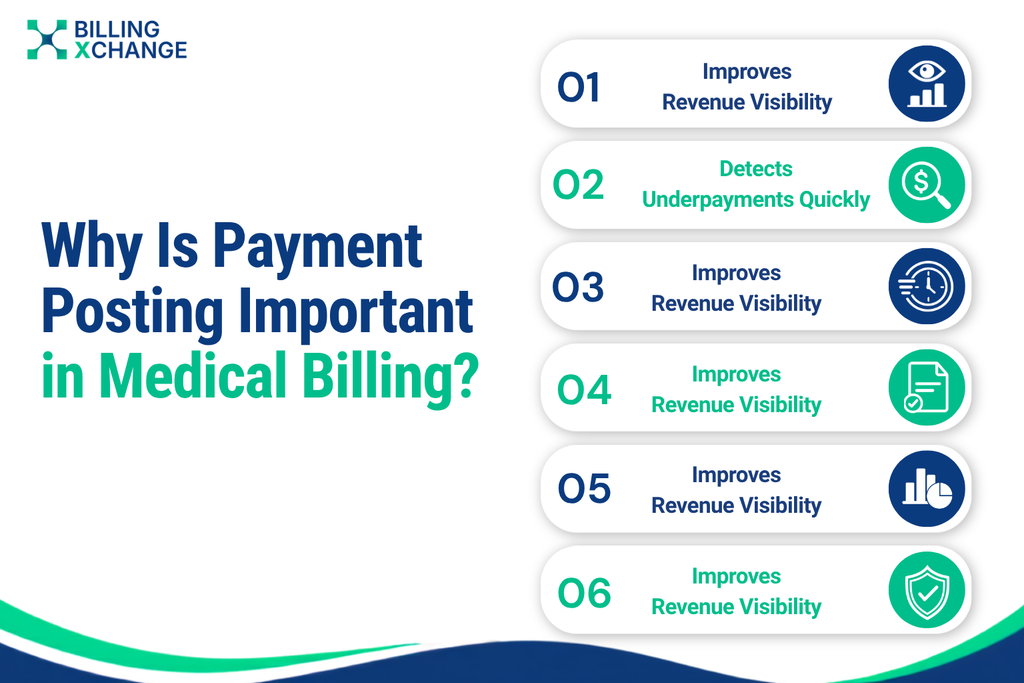
Accurate Payment Posting is essential for a healthy revenue cycle because it ensures payments match payer contracts, patient responsibilities, and claim outcomes. It helps healthcare organizations reduce billing errors, improve financial reporting, identify payment variances quickly, and prevent revenue loss.
1. Improves Revenue Visibility
- Organizations gain a clear understanding of collected revenue, outstanding balances, contractual adjustments, and pending reimbursements.
- Accurate financial visibility enables leadership teams to make informed operational and budgeting decisions based on real reimbursement data.
2. Detects Underpayments Quickly
- Insurance companies occasionally reimburse less than contracted amounts.
- AccurateThis process helps billing specialists compare received payments with expected reimbursements so underpayments can be identified and appealed promptly.
3. Supports Faster Account Resolution
- When payments are posted immediately through an efficientPayment Posting Process, remaining balances become visible sooner.
- Billing teams can contact patients, submit secondary claims, or begin denial follow-up without unnecessary delays.
- Organizations that combine Accurate payment recording with efficient Dental Billing operations often experience smoother account management and stronger reimbursement performance.
4. Reduces Billing Errors
- Incorrect account balances confuse both providers and patients.
- A consistent Payment Posting Practices minimizes duplicate entries, posting mistakes, and reconciliation issues while improving overall billing accuracy.
5. Enhances Financial Reporting
- Executives rely on accurate financial reports to evaluate organizational performance.
- Reliable posting provides trustworthy reimbursement data that supports forecasting, budgeting, and revenue analysis.
6. Strengthens Compliance
- Healthcare organizations must maintain accurate financial documentation for audits and regulatory requirements.
- Detailed posting records improve transparency while supporting compliance across billing operations.
Organizations looking to optimize reimbursement workflows frequently adopt standardized Payment Posting Services to improve consistency, reporting accuracy, and operational efficiency.
What Are the Different Types of Payment Posting?
Healthcare organizations receive payments from multiple sources, making it essential to use a structured Payment Posting approach for each transaction. Understanding the different types of This process helps billing teams improve financial accuracy, reduce reconciliation errors, and maintain a healthy revenue cycle.
1. Insurance Payment Recording
- Records Insurance Reimbursements: Posts payments received from commercial insurers, Medicare, Medicaid, and other third-party payers.
- Verifies Payment Accuracy: Reviews EOBs, ERAs, contractual adjustments, deductibles, copayments, and coinsurance to ensure accurate reimbursement.
2. Patient Payment Recording
- Posts Direct Patient Payments: Records payments received through cash, checks, credit/debit cards, online portals, and payment plans.
- Maintains Accurate Account Balances: Updates patient accounts promptly to prevent duplicate billing and outstanding balance errors.
3. Electronic Payment Recording
- Processes ERA and EFT Payments: Uses electronic remittance and fund transfers to automate payment recording.
- Improves Efficiency and Accuracy: Reduces manual entry while speeding up reconciliation and reimbursement tracking.
4. Manual Payment Recording
- Records Paper-Based Payments: Enters information from paper EOBs, checks, and manual payment documents.
- Supports Complex Claims: Ensures accurate posting for specialty services and claims requiring detailed review.
Comparison of Payment Posting Types
| Type | Primary Source | Main Benefit | Best Use |
| Insurance Payment Posting | Insurance Companies | Accurate reimbursement tracking | High insurance claim volumes |
| Patient Payment Recording | Patients | Updated patient balances | Direct patient collections |
| Electronic Payment Recording | ERA & EFT | Faster processing with fewer errors | Automated revenue cycle workflows |
| Manual Payment Recording | Paper EOBs & Checks | Greater control for complex cases | Specialty practices and exceptions |
How Does the Payment Posting Process Work?
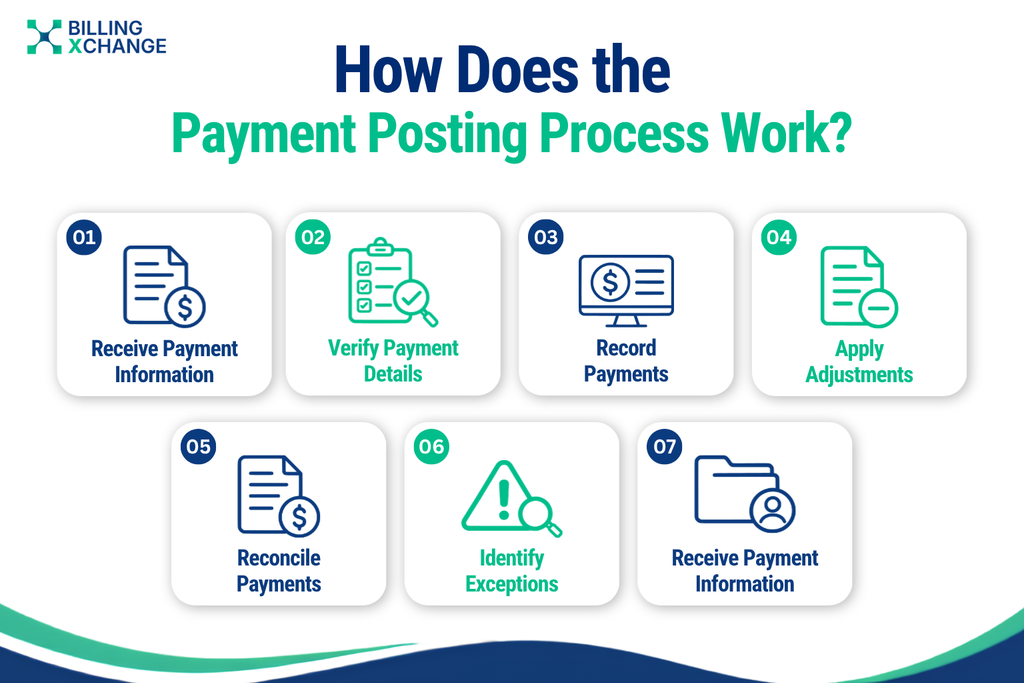
An effective Payment Posting workflow follows a structured process to accurately record and reconcile every payment against submitted claims, while experienced Medical Billing professionals verify payment accuracy and resolve exceptions to ensure reliable financial records.
Step 1: Receive Payment Information
- Electronic Remittance Advice (ERA)
- Explanation of Benefits (EOB)
- Electronic Funds Transfer (EFT)
- Patient payments
- Credit/debit card payments
- Checks
Step 2: Verify Payment Details
- Patient information
- Claim number
- Insurance payer
- Payment amount
- Service dates
- Procedure codes
- Adjustment codes
- Patient responsibility
Step 3: Record Payments
- Enter payment details into the billing system
- Update patient account balances
- Record insurance reimbursements
- Apply deductibles and copayments
Step 4: Apply Adjustments
- Contractual adjustments
- Allowed amounts
- Non-covered services
- Coinsurance
- Copayments
- Deductibles
Step 5: Reconcile Payments
- Compare payments with submitted claims
- Verify reimbursement amounts
- Review contractual adjustments
- Confirm outstanding balances
Step 6: Identify Exceptions
- Partial payments
- Underpayments
- Incorrect adjustments
- Missing claims
- Duplicate payments
- Denied services
Step 7: Prepare Accounts for Follow-Up
- Patient billing
- Secondary insurance billing
- Appeal submission
- Denial management
- Collections
- Account closure
What Are the Best Practices for Accurate Payment Posting?
Accurate Payment Posting requires a structured workflow that improves reimbursement accuracy, reduces payment discrepancies, and supports a more efficient revenue cycle. Following proven best practices helps healthcare organizations maintain consistency, improve accuracy, and strengthen revenue cycle performance.
Verify Every Payment Before Posting
- Patient information
- Claim number
- Procedure codes
- Payment amount
- Allowed amount
- Contractual adjustments
Reconcile Payments Daily
- Compare posted payments with submitted claims
- Identify payment discrepancies quickly
- Resolve outstanding payment variances
- Update account balances regularly
Monitor Underpayments
- Review expected reimbursement amounts
- Compare actual payer payments
- Identify underpayments promptly
- Initiate timely follow-up
Standardize Posting Procedures
- Follow documented workflows
- Use standardized posting guidelines
- Maintain consistent quality checks
- Train billing staff regularly
Leverage Automation with Human Oversight
- Automate routine payment workflows
- Review payment exceptions manually
- Verify ERA and EOB accuracy
- Resolve complex reimbursement issues
Track Key Performance Indicators (KPIs)
- Payment turnaround time
- Posting accuracy rate
- Underpayment rate
- First-pass reconciliation rate
- Outstanding accounts
- Revenue recovery rate
Why Choose BillingXchange for Payment Posting Services?
Managing payment posting internally requires experienced staff, consistent quality control, and continuous monitoring. BillingXchange provides reliable Payment Posting Services to help healthcare organizations improve reimbursement accuracy, reduce administrative workload, and strengthen financial performance.
Our billing specialists verify payments, reconcile EOBs and ERAs, identify payment variances, and maintain accurate financial records. We also support electronic and manual payment processing, contractual adjustment verification, and comprehensive revenue reporting.
With BillingXchange, healthcare providers benefit from faster reimbursement visibility, improved revenue cycle efficiency, and scalable billing solutions that minimize errors while enhancing financial transparency.
Conclusion
Accurate Payment Posting is essential for maintaining a healthy revenue cycle. It improves financial reporting, accelerates reimbursement tracking, strengthens cash flow, and reduces posting errors through consistent and efficient workflows.
Partnering with BillingXchange helps healthcare organizations streamline reimbursement workflows, improve payment accuracy, and enhance revenue cycle performance while allowing providers to focus on delivering quality patient care.
Contact us today for BillingXchange to learn how our billing specialists can streamline your billing operations and support long-term revenue growth.
Frequently Asked Questions (FAQs)
Payment Posting is the process of recording insurance and patient payments, applying contractual adjustments, updating account balances, and reconciling reimbursements after claims are processed.
Accurate payment recording reduces billing errors, improves financial reporting, identifies underpayments, accelerates reimbursement tracking, and supports a healthier revenue cycle.
Payment recording is typically handled by trained Medical Billing professionals who review EOBs, ERAs, insurance payments, patient payments, and contractual adjustments before updating billing systems.
Yes. Many healthcare organizations use ERA and EFT integrations to automate payment workflows. However, experienced billing specialists should still review transactions to ensure accuracy and resolve exceptions.
Outsourcing helps improve accuracy, reduce administrative workload, accelerate reconciliation, enhance reporting, and allow healthcare providers to focus on patient care while billing experts manage financial operations.